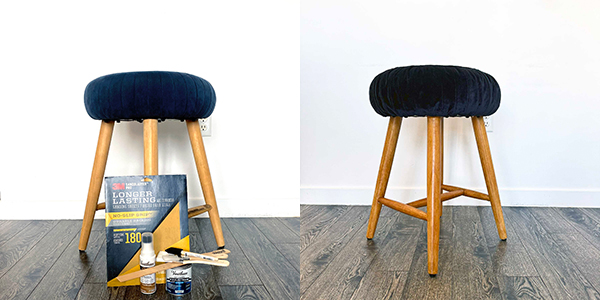
If you entertain a lot, dining and bar chairs need to be upholstered occasionally. I restored the bar chair in the picture with handsewn black velvet after a merry night with sparklers. Replacing the fabric on a seat is straightforward, requiring nothing more than a little time, some tracing paper, and a needle and thread.
Preparing the pattern
To create a pattern for your seat, the first thing you’ll need to do is to select a seam allowance, ranging from 3/8 inch to 5/8 inch. Once you’ve chosen your seam allowance, you’ll need to look closely at the existing upholstery to identify the seams and determine how many pattern pieces there are.
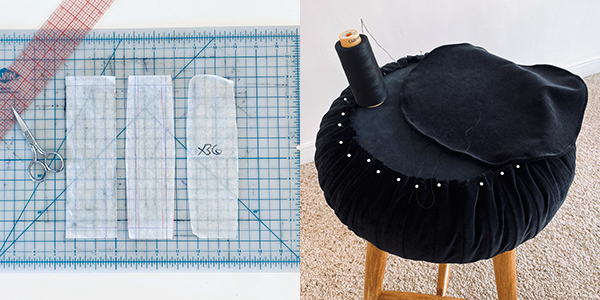
The upholstery for the chair in the picture was made with two pattern pieces, a circle for the top and 36 diamond-like pieces to encircle the seat. To make each pattern piece, start by cutting a piece of tracing paper as close as possible to the existing seams in the original fabric with your seam allowance. For this chair, I had to cut a circle and a curved diamond.
To fit the curved diamond to the chair precisely, I placed the tracing paper over the chair and used a permanent marker to trace a line around the fabric. I cut the tracing paper for the pattern piece three times. The first time in a rectangle, then in a diamond, and finally the curves to fit the chair.
Sewing your new seat cover
Some of the do-it-yourself how-to’s on upholstering seats involve sticky glue and staple guns. Yikes! Not only do you not need glue or staples, you don’t even need to be very good at sewing to assemble the fabric for a seat.
To start, you’ll need to sew an overlock stitch along the raw edge of all your pattern pieces. Then, you can assemble your cover using a straight stitch.
Before attaching the cover to your chair, you’ll need to fold the bottom edge according to your seam allowance (3/8 inch to 5/8 inch) and attach it to the inside of the cover with a straight stitch. For this, you’ll sew about 1/8 inch within the allowance. So, if you have a 3/8-inch seam allowance, you’ll need to sew about 1/4-inch from the crease.
Finally, you can leave the original fabric on your chair and attach the cover on top of the original fabric. This takes only a few minutes to do using a hem stitch by hand. A hem stitch doesn’t involve any of the mess of glue or staples and gives a beautiful, handmade appearance to the underside of the chair.
Read about how I refinished the wood on this bar chair to match the aesthetic of my living room.