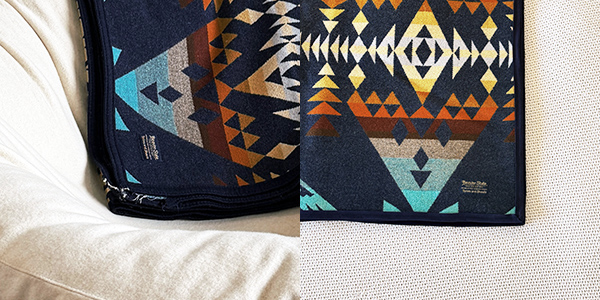
Sooner or later, you will likely have a blanket that needs to be rebound. My puppy loves Pendleton blankets, but the binding the blanket in the picture came with was not a puppy-friendly material. I rebound the blanket with a more durable binding and mitered corners.
You don’t need amazing sewing skills to bind a blanket. However, you do need to be precise and accurate at measuring fabric. Using stable, woven fabrics like twill is helpful if you’re a novice at sewing.
Choosing the binding
When choosing new binding for a blanket, you need to decide on three things: measurements, material, and colour.
To measure the width of the binding you need, you want to measure the existing binding somewhere in the middle of the blanket (not at the corner). If the blanket is thick, you may want to add 1/16-inch to 1/8-inch to the measurement. For this blanket, I decided on 5/8-inch binding and bought bias tape that was 1-1/4 inches when unfolded.
For the binding material, I needed to find something more durable than the original felt that the blanket came with. With a puppy in my home, I chose to look at outdoor fabrics rather than indoor fabrics as they are designed for more wear and tear. The bias tape I purchased was a Sunbrella bias tape that is typically used for sailing.
Matching fabric colours is not always easy when shopping online. Taking your blanket with you to a store is the quickest way to shop. For this blanket, I ordered several shades of navy and royal blue and chose the shade of blue that complemented the blanket’s pattern by increasing rather than dulling the vibrancy of the other colours in the blanket.
How to use one continuous length of binding
Some people cut 4 pieces of binding and sew each side of a blanket separately. You can bind a blanket without wasting any bias tape if you use one continuous length of binding. To do this, you’ll need to measure the perimeter of the blanket carefully and purchase an additional 6 inches of bias tape to be cautious. For this blanket, I started with 25 feet of bias tape.
Prior to attaching the binding, I closed the ends of the bias tape so that I would be working with a loop. The most important step to closing the ends is to measure very carefully first. If you make a mistake, your bias tape won’t fit the blanket.
Once you’ve measured the length of the bias tape to match the blanket, you can cut a 45-degree angle across each end and join the pieces. For this bias tape, I used a 5/16-inch overlap and then stitched with a zigzag stitch.

Sewing mitered corners
Sewing mitered corners is the trickiest part of binding a blanket. There are several ways to create them. The method I used is one of the simplest methods. It does involve cutting the corners of the bias tape with scissors, so if you want to use this method you’ll need to make sure you measure everything exactly right.
In the picture, the bias tape was cut at a 90-degree angle to the edge of the tape. There are two cuts, one on each side, with 1/2-inch of uncut tape remaining to cover the blanket corners. You can then iron and sew the cut ends, shaping the bias tape as you sew to fit the blanket corner. After shaping the bias tape corners, you’re ready to attach the bias tape to the blanket.

Now that this Pendleton blanket has been rebound with a tough, outdoors bias tape, it’s become my puppy’s favourite blanket. She enjoys sitting on it, while I have peace of mind that the bias tape is durable enough for the wear and tear of puppy play.
Find where to shop for Pendleton blankets and outdoors fabrics.